When Should Veterinary Clinics Replace Their Pet Mats? A Safety & Hygiene Guide
Let’s say this upfront: Most veterinary clinics replace their pet

If your clinic or grooming facility has a sanitation SOP for surgical tools but not for floor-level equipment…
That’s a gap.
Because here’s the reality: Pet mats are in high contact with high-contamination surfaces. They collect:
And in professional environments, that means one thing: “Pathogen control in clinics starts from the ground up.”
According to the Centers for Disease Control and Prevention (CDC), contaminated surfaces can contribute to cross-contamination when cleaning and disinfecting procedures are inconsistent or ineffective.
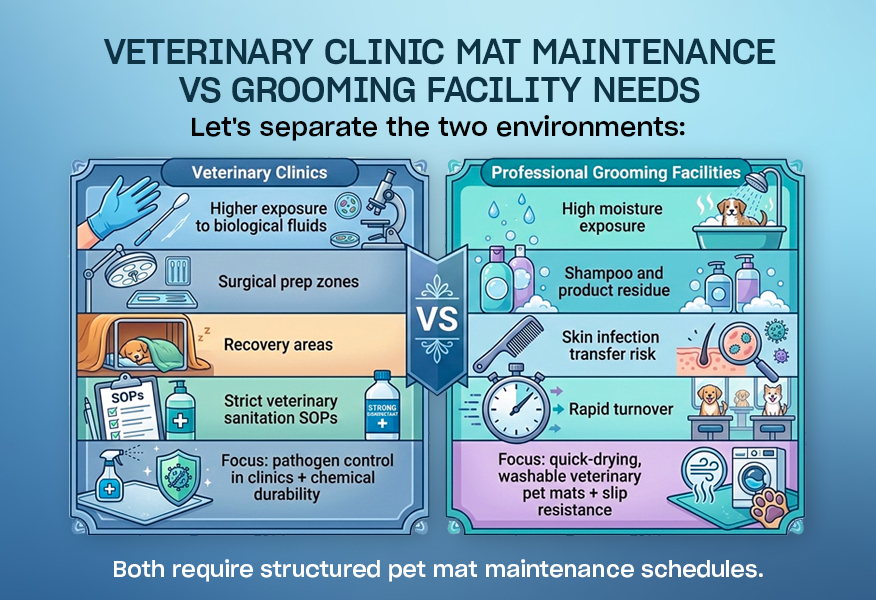
In veterinary and professional grooming facilities, exposure risk increases due to:
In grooming settings specifically, failure to disinfect equipment and surfaces properly can allow pathogens to transfer between animals, especially in high-turnover environments.
In short:
Grooming hygiene standards and veterinary sanitation SOPs now demand structured maintenance protocols, not casual wipe-downs.
This is your operational framework. Use it daily, weekly, and monthly.
Vacuum or shake mats to remove fur and dander before wet cleaning. Organic buildup reduces disinfectant effectiveness.
Use warm water and clinic-approved detergent to remove visible soil. Cleaning must happen before disinfecting because disinfectants don’t penetrate dirt.
Follow label instructions precisely, especially dwell time. Improper contact time reduces pathogen elimination effectiveness.
(According to CDC guidance, disinfectant must remain wet on the surface for the full time stated on the label to properly disinfect.)
Moisture retention promotes microbial survival. Never stack or reuse damp mats.
Check for:
Damaged surfaces trap contaminants and reduce disinfectant penetration.
Persistent odour may indicate microbial buildup beneath the surface. If odour remains post-cleaning, replacement evaluation should begin.
Rotating reduces uneven wear and extends lifespan. This is especially critical for grooming facility sanitation mats in bathing and drying zones.
Check foam rebound (if cushioned). Inspect backing adhesion and dimensional stability.
Hospital-grade disinfectants degrade low-quality rubber over time. Ensure your mats are disinfectant-safe pet mats built for repeated sanitation cycles.
Documentation supports compliance during inspections. Veterinary sanitation SOPs increasingly require recordkeeping for hygiene audits.
If you’re training new staff, here’s the veterinary-approved pet mat cleaning process:
In grooming facilities, disinfecting is especially critical due to exposure to skin infections, parasites, and dermatological conditions.
Cross-contamination prevention depends on consistency.
Silicone mats are increasingly used in professional facilities due to:
Best practice:
Silicone performs well under repeated sanitation cycles, but only when cleaned correctly.
Some commercial pet mats advertise antimicrobial materials. Important clarification:
Antimicrobial ≠ self-cleaning.
These surfaces may inhibit bacterial growth, but do not replace:
Think of antimicrobial properties as risk reduction, not immunity.
Even with perfect maintenance, commercial pet mats have lifespan limits.
Replace them if:
Cleaning extends lifespan. It does not make the mats permanent. So, keep the track.
Maintenance burden often comes down to product quality. When evaluating pet mats for professional facilities, look for:
Low-maintenance mats reduce:
If your team is constantly struggling to remove stains or odours, that’s usually a material issue, not a cleaning issue.
❌ Skipping debris removal before disinfecting
❌ Not respecting disinfectant dwell time
❌ Reusing damp mats
❌ Using bleach on incompatible materials
❌ Ignoring early wear signs
❌ Failing to document maintenance
These shortcuts directly increase cross-contamination risks.
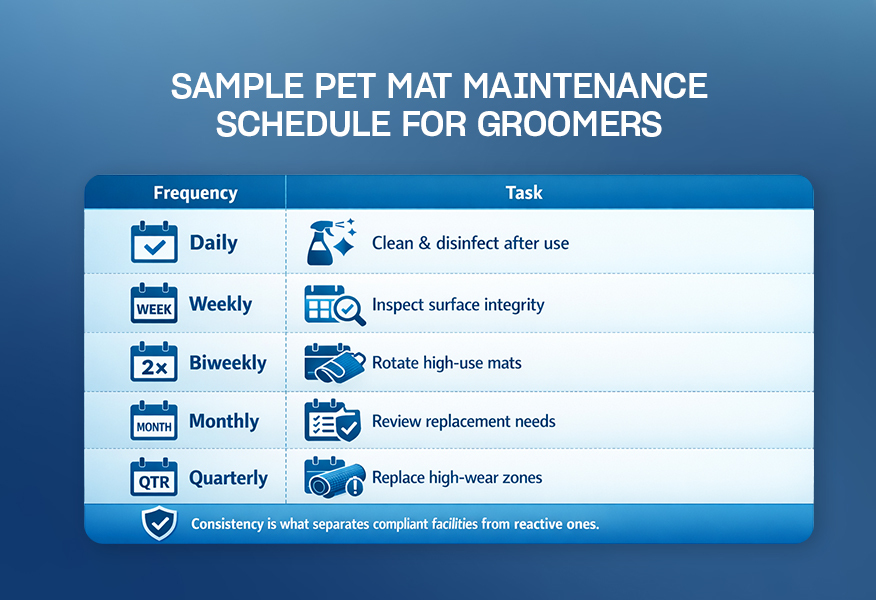
Modern pet owners are observant.
They notice:
In a market where veterinary and grooming competition is increasing, hygiene perception influences brand credibility.
Maintenance isn’t just operational. But reputational.
Before ending your week, confirm:
If all six are covered, your facility is operating at 2026 hygiene standards.
Pet mat maintenance isn’t a side task. It’s a core infection control strategy.
Whether you run a veterinary clinic or a professional grooming facility, your mats are part of your pathogen control system. So,
That’s how professional facilities operate in 2026.
Let’s say this upfront: Most veterinary clinics replace their pet
If your clinic or grooming facility has a sanitation SOP
Foam mats look innocent enough. Soft, cushy, and budget-friendly. What
Let’s be honest for a second! Most people don’t think

Picture this: a nervous pup stepping onto a shiny stainless‑steel
Every grooming facility hits this question sooner or later: Do